

When we think of nature, it's easy to picture a forest, an ocean, or a coral reef as a collection of individual plants and animals. But what makes these places truly alive is the web of connections that binds everything together. Every leaf, insect, bird, and drop of water plays a role in a living system that sustains itself. This is the essence of ecology — the study of how organisms interact with each other and their environment.
The Building Blocks of an Ecosystem
At its core, an ecosystem is made up of living components (plants, animals, microbes) and non-living factors (sunlight, water, soil, temperature). These elements are interconnected through the flow of energy and the cycling of nutrients.
Plants, known as producers, form the base of the system by capturing sunlight and converting it into energy through photosynthesis. (For a deeper look at how photosynthesis actually works and why plants do so much more than just sit there being green, see The Secret Life of Plants.) Herbivores consume plants, carnivores eat other animals, and decomposers break down organic matter, returning nutrients to the soil. It's a continuous loop that keeps the system in motion.
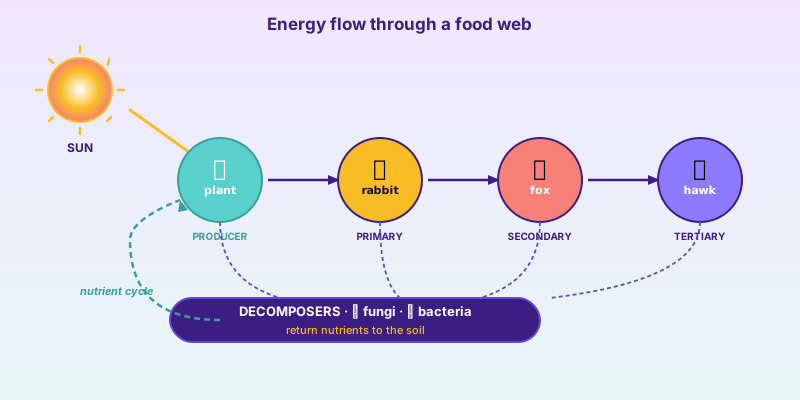
The Web of Relationships
Ecosystems thrive on relationships — some visible, many hidden. A bee pollinating a flower seems like a simple act, but it triggers a chain of events that affects entire food webs. Birds rely on pollinated plants for fruit, and larger animals may depend on those birds for food.
These interactions are not always cooperative. Predation, competition, and parasitism also shape ecosystems, maintaining balance. Predators, for example, control herbivore populations, preventing them from overgrazing. Even a single change, like the loss of a key species, can ripple through the system, affecting everything else.
Biodiversity: The Strength of the System
The richness of an ecosystem lies in its biodiversity — the variety of species and their roles. A diverse ecosystem is more resilient. When one species declines, others can often fill its niche, allowing the system to adapt and recover.
In contrast, ecosystems with low biodiversity are more fragile. If a single species disappears, the entire structure can weaken. This is why rainforests, coral reefs, and wetlands — some of the most biodiverse ecosystems on Earth — are so crucial to the planet's stability. We cover the specific places that matter most in Biodiversity Hotspots: Protecting Earth's Most Vital Regions, and the ocean side of the story in The Amazing World of Marine Biology.
Ecosystem Services: Nature's Invisible Work
Healthy ecosystems provide countless benefits, often without us noticing. Forests filter air and water. Wetlands prevent floods. Oceans regulate climate. Bees and other pollinators support global food production. These ecosystem services are the foundation of human well-being, even though they rarely appear on any balance sheet.
When ecosystems are damaged, these services weaken or vanish, often at great cost. Protecting ecosystems is not just about saving wildlife — it's about securing the natural systems that sustain us.
Human Impact and Responsibility
Human activity has dramatically reshaped ecosystems. Deforestation, pollution, overfishing, and climate change are pushing many systems to their limits. Yet, humans also have the power to restore balance. Conservation efforts, reforestation, sustainable farming, and habitat protection can help ecosystems recover and thrive — and biology itself is increasingly central to that fight, as we explore in The Role of Biology in Combating Climate Change.
A Living Network
Ecosystems are like intricate tapestries. Every thread matters, and every connection supports the whole. Ecology shows us that nothing in nature exists in isolation. The survival of one species often depends on many others, forming a network that has evolved over millions of years.
Protecting that network means protecting life itself — including our own. The more we understand how ecosystems work, the better equipped we are to live in harmony with the natural world, rather than against it.