
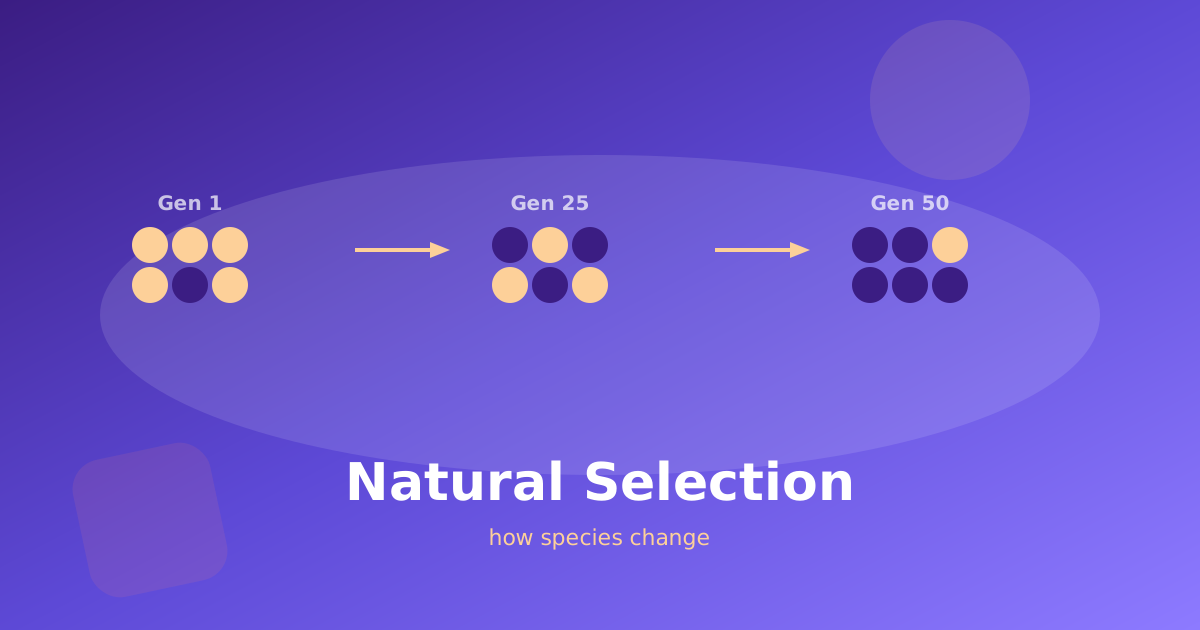
If you only learn one idea from biology, learn this one. Natural selection is the mechanism that drives evolution. It's not random, it's not progressive in any value-laden sense, it isn't trying to produce anything — and it produces, over deep time, every organism on Earth, every adaptation in every body, and every behavior in every species.
It is also, despite being the central idea in all of biology, one of the most consistently misunderstood concepts in any science. Almost everyone has heard the phrase "survival of the fittest"; almost no one has it quite right.
The Four Things You Need
Natural selection happens whenever four conditions are all true in a population:
- Variation. Individuals in the population are not identical. Some are taller, some shorter; some have thicker fur, some thinner; some can digest a particular sugar better than others.
- Heritability. Some of that variation is heritable — passed from parents to offspring. (Variation that comes purely from the environment doesn't count. A tan from sun exposure isn't inherited; the tendency to tan well is.)
- Competition for reproduction. More offspring are produced in each generation than the environment can support. Not all will survive to reproduce.
- Differential reproduction. Some heritable variations make individuals more likely to survive and reproduce in the current environment than others.
That's the whole machine. Whenever all four are present — and they always are, in any population of anything — the population will change over generations. The heritable variations that lead to more surviving offspring will become more common; the ones that don't will become less common. Repeated over thousands or millions of generations, this slow ratchet produces every feature of every organism that has ever existed.
What "Fitness" Actually Means
"Survival of the fittest" is a slogan that does the actual concept a lot of damage. In ordinary English, "fit" implies strength, speed, or being in shape. In evolutionary biology, fitness means something much more specific: the number of viable offspring an organism produces relative to others in the same population.
A tiny, weak, slow organism that happens to produce 50 healthy offspring is more fit, in the evolutionary sense, than a strong, fast, athletic one that produces 3. Fitness is just reproductive success. Survival matters only because you have to survive to reproduce.
This is why so many "fit" traits seem counterintuitive. A male peacock's tail is enormous, energetically expensive, and makes it harder to escape from predators. By any common-sense measure, the tail is a disaster. Evolutionarily, it persists because peahens prefer males with bigger, more colorful tails — and "more offspring" trumps "easier to escape predators" every time.
What Natural Selection Doesn't Do
Several things that natural selection is constantly accused of doing — but doesn't actually do:
- It doesn't have a goal. Evolution isn't aiming at anything. There's no end state, no perfection, no "next stage." The current state of every species is just what's left after generations of whatever-worked-best-in-the-moment.
- It doesn't act on individuals. Individuals don't evolve; they live and die unchanged. Populations evolve, as the frequency of different traits shifts over generations.
- It doesn't produce new variation. Variation comes from mutation, recombination, and (rarely) horizontal gene transfer. Natural selection only sorts what already exists.
- It isn't always slow. Bacteria evolve antibiotic resistance in months. Lizards on Caribbean islands have evolved measurably different leg shapes within a single human lifetime when their habitat changed.
- It isn't always optimizing. Natural selection works on what's available. If the best-adapted trait isn't currently present in the population's gene pool, it can't be selected for, no matter how useful it would be.
A Concrete Example
The textbook example is the peppered moth in industrial England. Before the Industrial Revolution, the moths were predominantly light-colored — well-camouflaged against light-colored tree bark and lichens. A small fraction were dark-colored variants; they stood out against the lichens and got eaten by birds at high rates.
Then the Industrial Revolution came, and soot darkened the tree bark and killed off the lichens. Suddenly, the dark moths were the camouflaged ones; the light moths stood out. Within a few decades, the population had shifted dramatically toward dark coloring. After clean-air laws cleaned up the soot, the population shifted back.
That's natural selection in real time. The dark-coloring allele was always there, at low frequency. The change in the environment changed which color was advantageous, and the population shifted. No moth ever evolved during its own lifetime; the population evolved across generations as different individuals reproduced at different rates.
Why It Matters
Natural selection is the single mechanism that makes the rest of biology cohere. Every other branch of biology — anatomy, physiology, ecology, behavior, even molecular biology — makes sense only in the context of selection acting over deep time.
It explains:
- Why the human eye is structurally similar to a squid's eye even though they evolved independently
- Why bacteria become resistant to antibiotics so quickly
- Why peacocks have ridiculous tails
- Why almost all animals have a head with eyes at the front (because that's what natural selection has consistently favored for predators and prey alike)
- Why human knees are kind of badly designed (because they were modified from a quadrupedal ancestor's hind limbs by selection that didn't have the freedom to redesign from scratch)
- Why your DNA shares 98.8% similarity with chimpanzees and 60% with bananas (covered in Top 10 Fascinating Facts About Human DNA)
For the longer story of how natural selection has shaped life on Earth across 3.8 billion years, see The Evolution of Life: A Journey Through Time.
For the modern genetic understanding that puts mechanism behind Darwin's original idea, see CRISPR — gene editing is, in some sense, what happens when humans try to do consciously what natural selection has been doing unconsciously forever.
The One-Sentence Version
Natural selection is the process by which heritable traits that improve reproductive success become more common in a population over generations. Everything else in biology is downstream of that.