

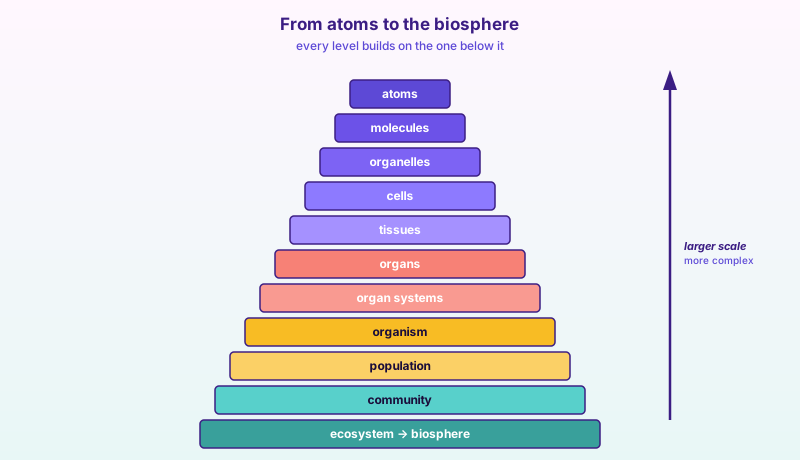
Life on Earth exists in countless forms, from invisible single-celled organisms to vast, interconnected ecosystems. Despite this incredible diversity, living things follow a structured hierarchy—a series of levels that build upon one another to create the complexity of life as we know it. Understanding this organization of life helps us see how everything is connected, from the smallest cell to the living planet itself.
Let's explore the different levels of biological organization and how each plays a vital role in sustaining life.
1. Cells: The Building Blocks of Life
Everything starts with the cell. Whether it's a single-celled bacterium or a human being made up of trillions of cells, all living organisms rely on cells to function.
Cells carry out essential life processes—like producing energy, removing waste, and reproducing. There are two main types:
- Prokaryotic cells, which lack a nucleus (like bacteria and archaea).
- Eukaryotic cells, which contain a nucleus and organelles (like plants, animals, and fungi).
Cells may be tiny, but they're astonishingly complex. Inside, proteins, organelles, and genetic material work together seamlessly, keeping the organism alive.
2. Tissues: Cells Working Together
When similar cells group together to perform a shared function, they form tissues. For example, in humans:
- Muscle tissue helps with movement.
- Nervous tissue transmits signals.
- Connective tissue supports and binds other structures.
- Epithelial tissue covers surfaces and lines organs.
Tissues are a key step in increasing complexity—they allow living things to specialize and become more efficient.
3. Organs: Coordinated Structures with a Purpose
An organ is made up of different tissues working in harmony to perform specific tasks.
- The heart, for example, has muscle tissue that pumps blood, connective tissue that supports its structure, and nervous tissue that regulates rhythm.
- In plants, leaves act as organs that carry out photosynthesis.
Organs are like well-organized teams—each part has a job, but together they accomplish something far greater.
4. Organ Systems: The Power of Collaboration
Organs don't work alone. They form organ systems, which keep the body functioning smoothly.
- In animals, the respiratory system works with the circulatory system to supply oxygen to the body.
- In plants, the root system and shoot system work together to absorb water and transport nutrients.
This level of organization allows for coordination across the entire organism, ensuring survival in changing environments.
5. Organisms: Independent Living Beings
An organism is an individual living entity. It can be as simple as a single-celled amoeba or as complex as a blue whale. Every organism carries out the basic functions of life: metabolism, growth, reproduction, and response to its surroundings.
Organisms come in astonishing diversity. Each species has evolved its own strategies to survive, from deep ocean microbes to towering redwoods.
6. Populations: Groups of the Same Species
When organisms of the same species live in a shared area, they form a population.
A population of wolves in a forest, for instance, may hunt together, mate, and compete for resources. Populations are important units of evolution—natural selection acts on individuals, but its effects are seen at the population level over time.
7. Communities: Different Species Interacting
A community includes all the populations living in the same area. Think of a coral reef: fish, corals, crustaceans, algae, and countless other species interact in a delicate balance.
These interactions—such as predation, competition, and cooperation—shape the structure of the community and influence which species thrive.
8. Ecosystems: Life and Environment Intertwined
An ecosystem includes living organisms (the biotic components) and their physical environment (the abiotic components), such as soil, water, and climate.
A rainforest, for example, is an ecosystem where plants, animals, microorganisms, sunlight, and rainfall are all interconnected. Energy flows through ecosystems, and nutrients are recycled in a continuous loop.
Ecosystems show that life isn't just about living things—it's about how those living things interact with the world around them.
9. Biomes: Large-Scale Ecological Regions
When similar ecosystems are grouped across large geographical areas, they form biomes. Examples include:
- Tropical rainforests
- Deserts
- Grasslands
- Tundra
Each biome has unique climate patterns and characteristic plant and animal life. These vast regions play a critical role in regulating Earth's climate and supporting biodiversity.
10. The Biosphere: Life on a Global Scale
At the highest level of organization is the biosphere—the thin, fragile layer of Earth where life exists. It includes land, water, and the atmosphere. All ecosystems on the planet are part of this interconnected system.
The biosphere is delicate. Changes in one part, such as deforestation or ocean pollution, can ripple across the globe. Protecting it means protecting life itself.
From a single cell to the entire biosphere, each level of biological organization builds on the one before it. This hierarchy shows how life is both intricate and interconnected—how microscopic actions can shape global processes, and how every organism plays a part in the bigger picture.